Technology Baseline Assessment
An independent technology baseline for the first 100 days
In 30 to 45 days, Technoscope measures the whole technology organization from the systems already in place, then reports progress against that baseline every month.
Salesforce, Cisco and Warner Bros. Discovery rely on the same assessment when they acquire a company.


Why a baseline
Every technology organization was built by many teams over many years. Technoscope gives the leader who inherits it an independent measure of where it stands, taken directly from the systems it runs.
The assessment
The whole technology organization, ranked by business risk
Each domain is measured against a stated reference. Every finding carries its evidence, the team that can close it and a due date.
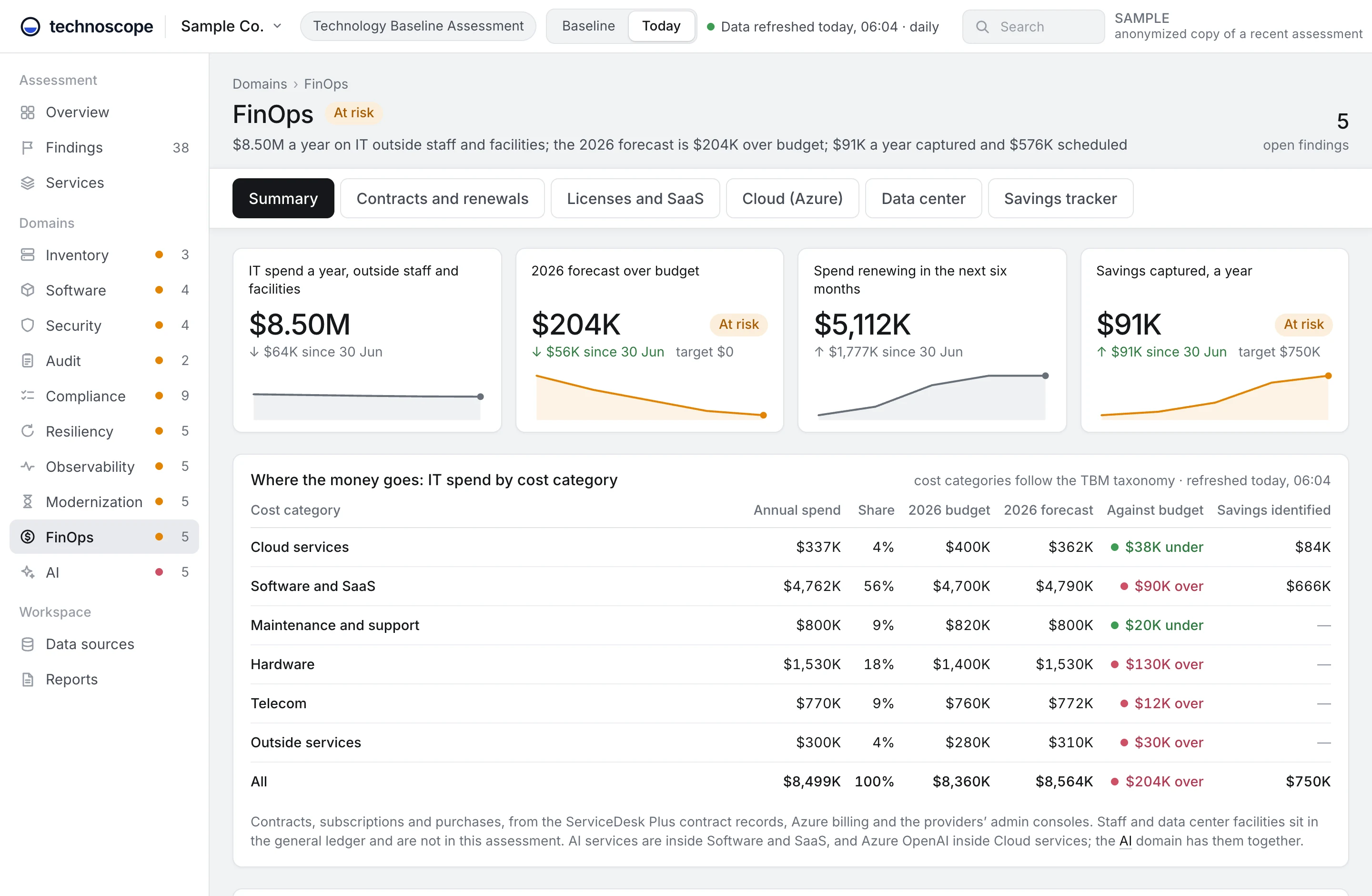
Where the IT budget goes, and where the year will end against it
Contracts, cloud billing and license consoles are read and sorted into standard cost categories. Renewals due in the next six months appear with their notice dates, and unused licenses with their annual cost.
Decisions it supports
- Contracts to resize or consolidate at renewal
- Savings to take this quarter
- The year-end forecast to give the CFO
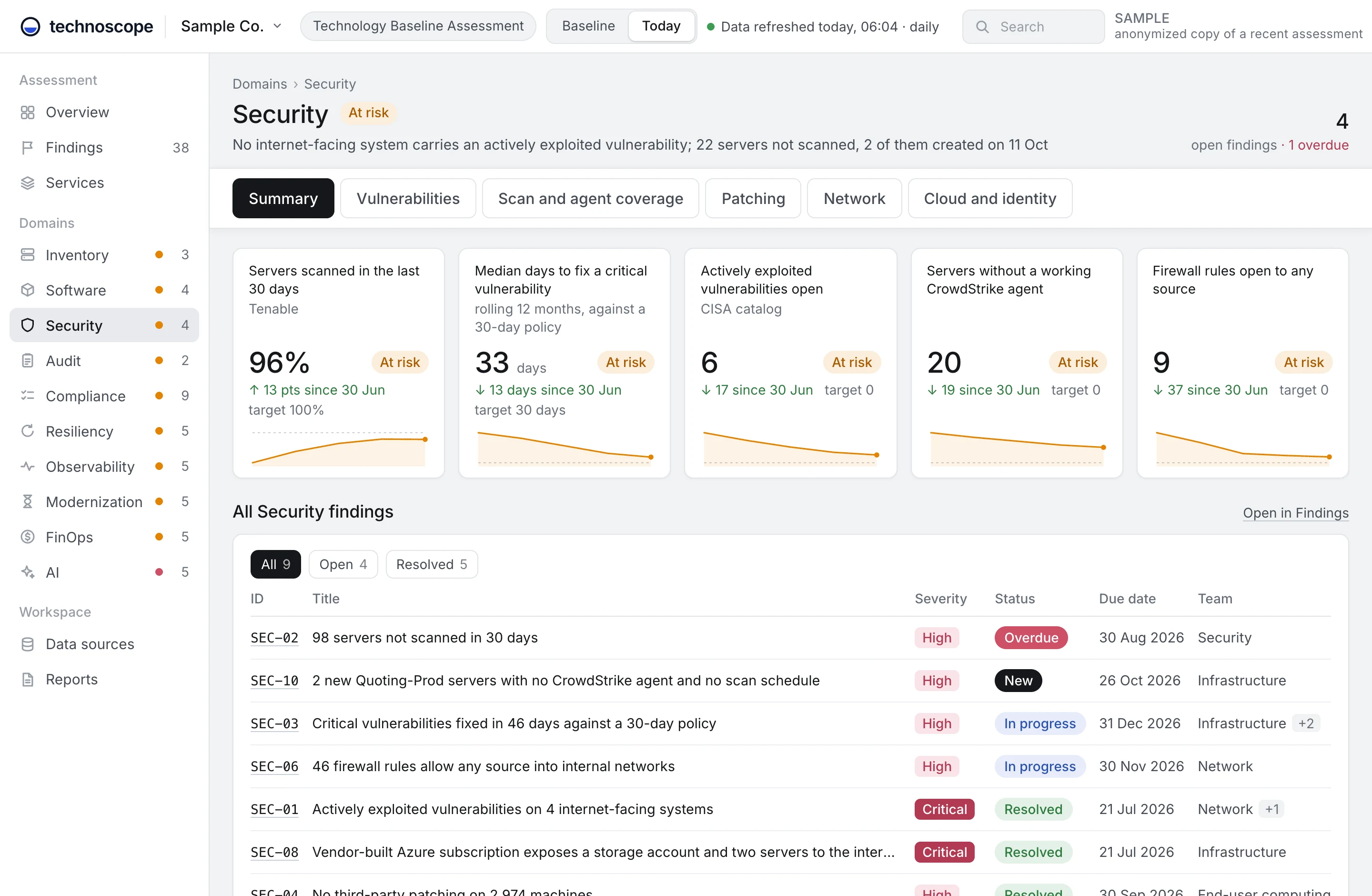
How much of the infrastructure the security tools reach, and whether fixes keep pace
Findings from the security tools already in place are matched to the full inventory, so machines no tool reaches are counted. Vulnerabilities under active attack are tracked until they close.
Decisions it supports
- The security position to report to the board
- Where scanning and endpoint protection go first
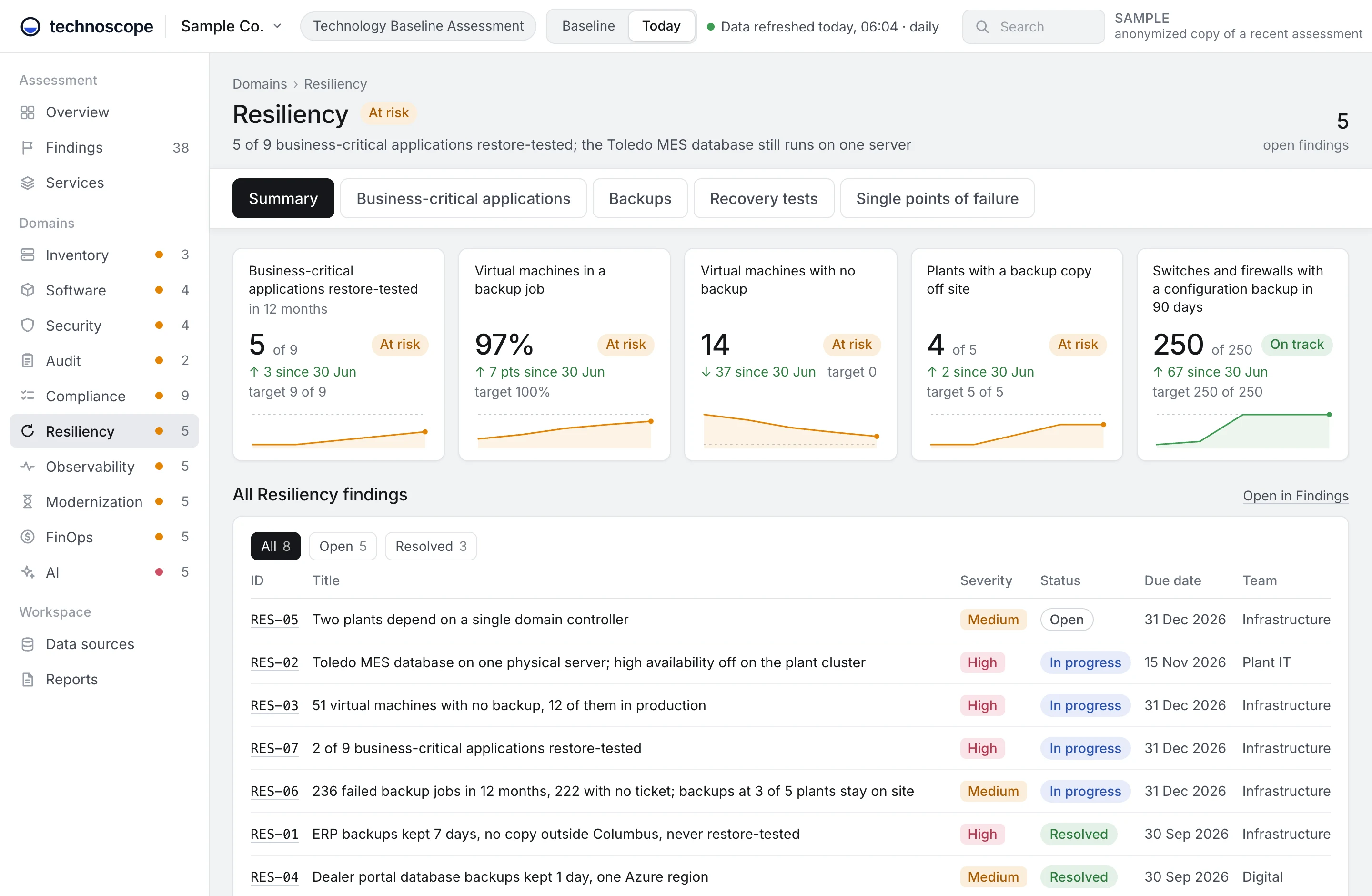
Which business-critical applications can be restored, and which depend on a single server
Each critical application is checked for single points of failure, missing backups and the date of its last restore test.
Decisions it supports
- Which applications to make resilient first
- The recovery tests to schedule this year
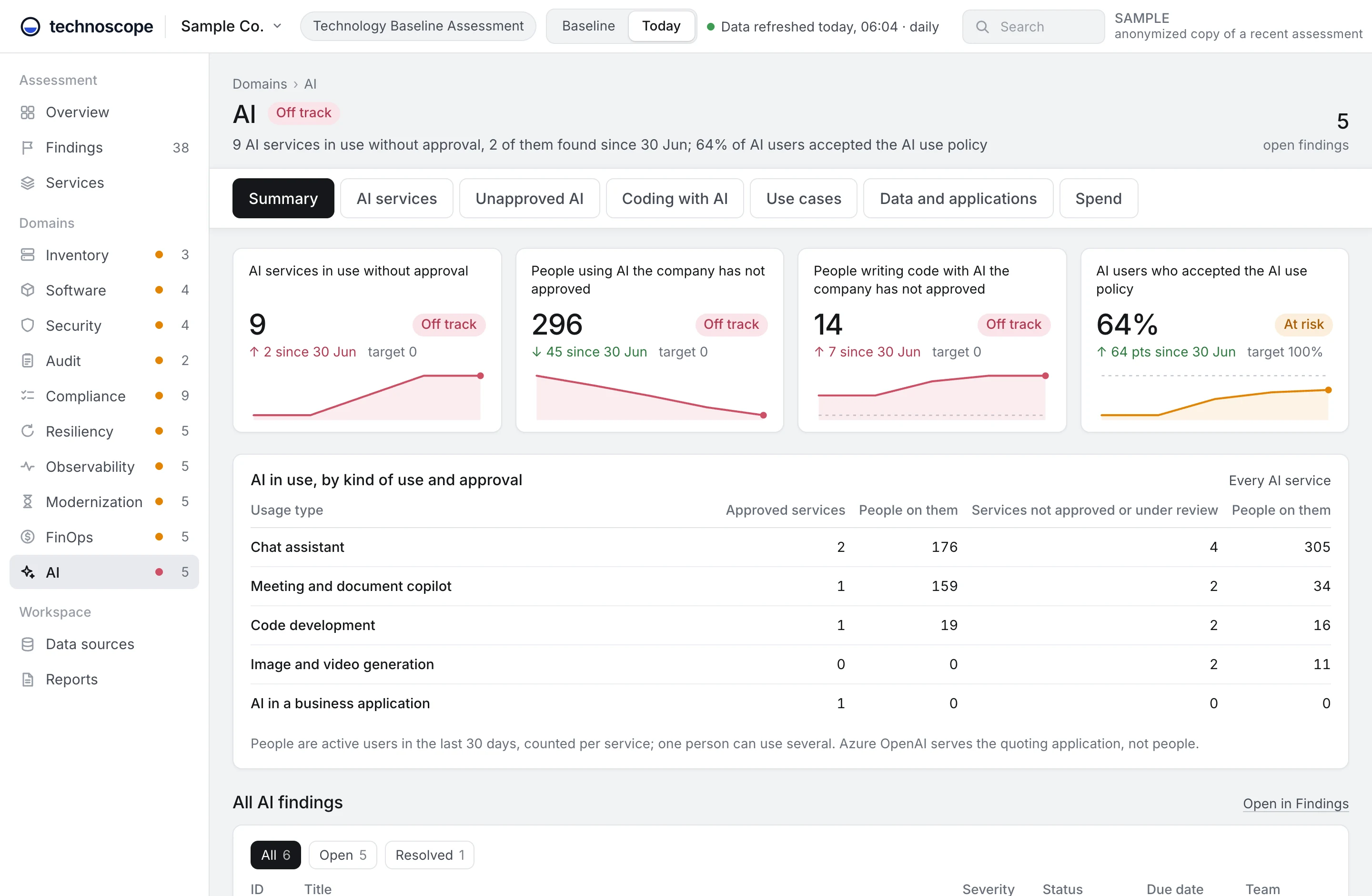
Which AI services are in use across the company, and which are approved
Every AI service is listed with its users, its approval and whether the provider trains on what it is given. Use cases are recorded with the data they touch.
Decisions it supports
- Which services to approve, replace or block
- Which teams move to company plans
How often critical services fail, and how fast they come back
The full incident history is read: P1 incidents each month, time to restore by service, and the causes that keep returning.
Decisions it supports
- Which recurring problems to fix at the root
- Where monitoring must be added before the next incident
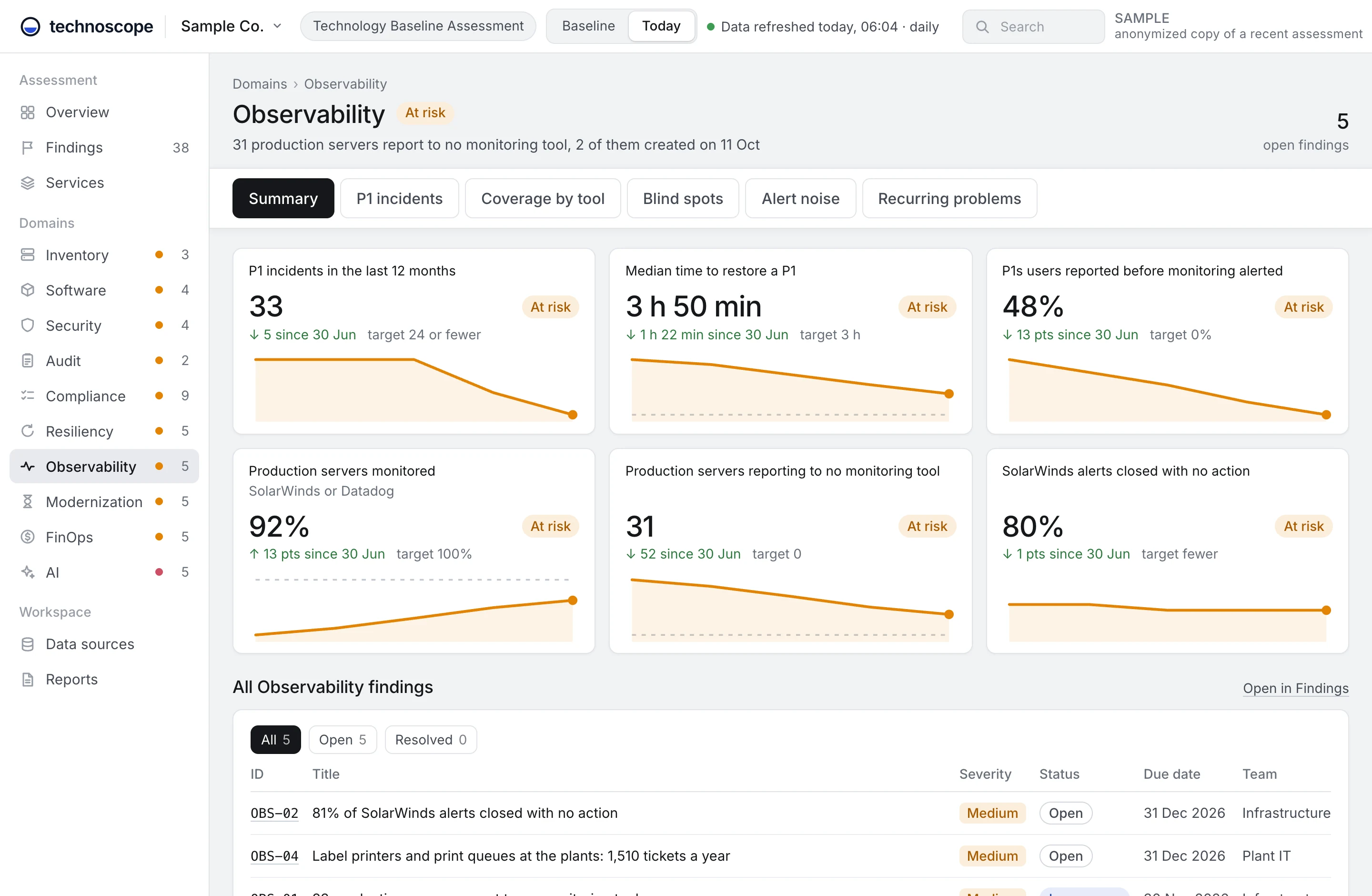
Every server, device and platform, including those missing from the CMDB
Discovery is compared with the CMDB. Each asset missing from it is listed with the consequence: not scanned, not backed up or not monitored.
Decisions it supports
- Systems to bring under management
- Accounts and servers to retire
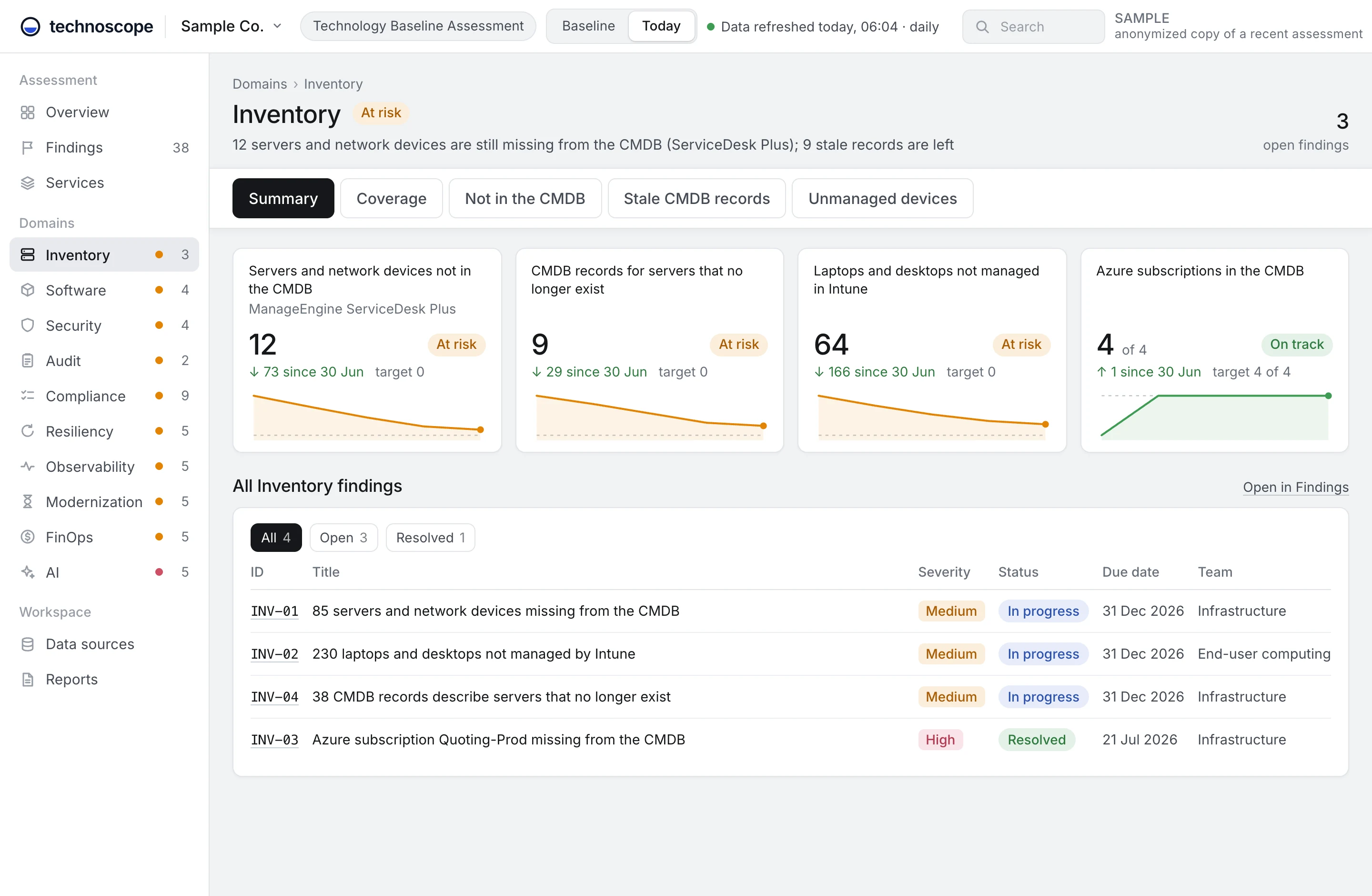
Software, audit, compliance and modernization are measured the same way.
Evidence
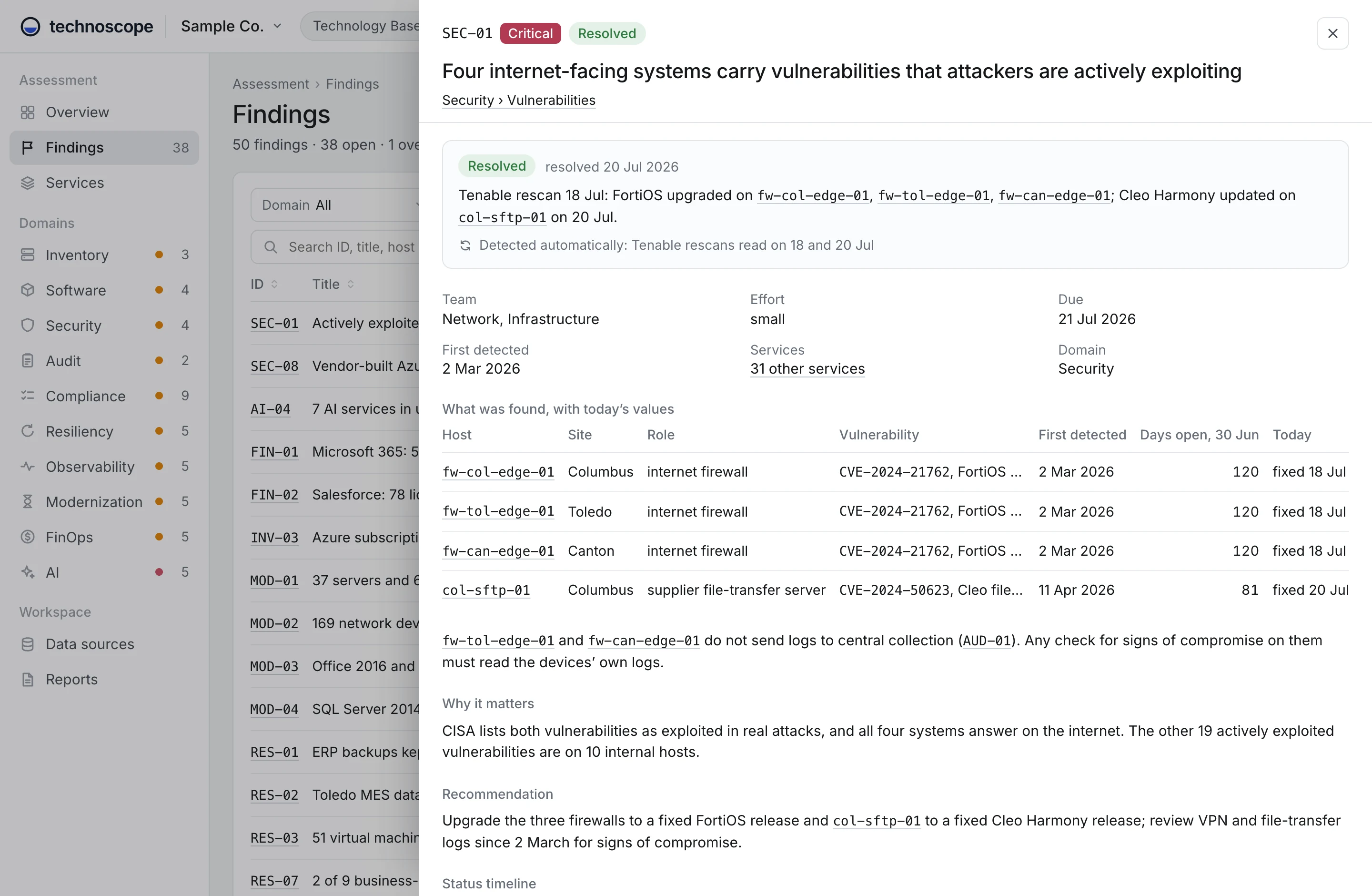
Each finding opens to the records behind it
Every fact is confirmed against a second source before it becomes a finding. The finding then shows the hosts, accounts and records it rests on.
- EvidenceHostnames, vulnerabilities, accounts and contract lines, with the source of each
- Next stepThe recommendation, the team that can carry it out and the effort involved
- Due dateAgreed at the readout and tracked until the finding closes
After the readout
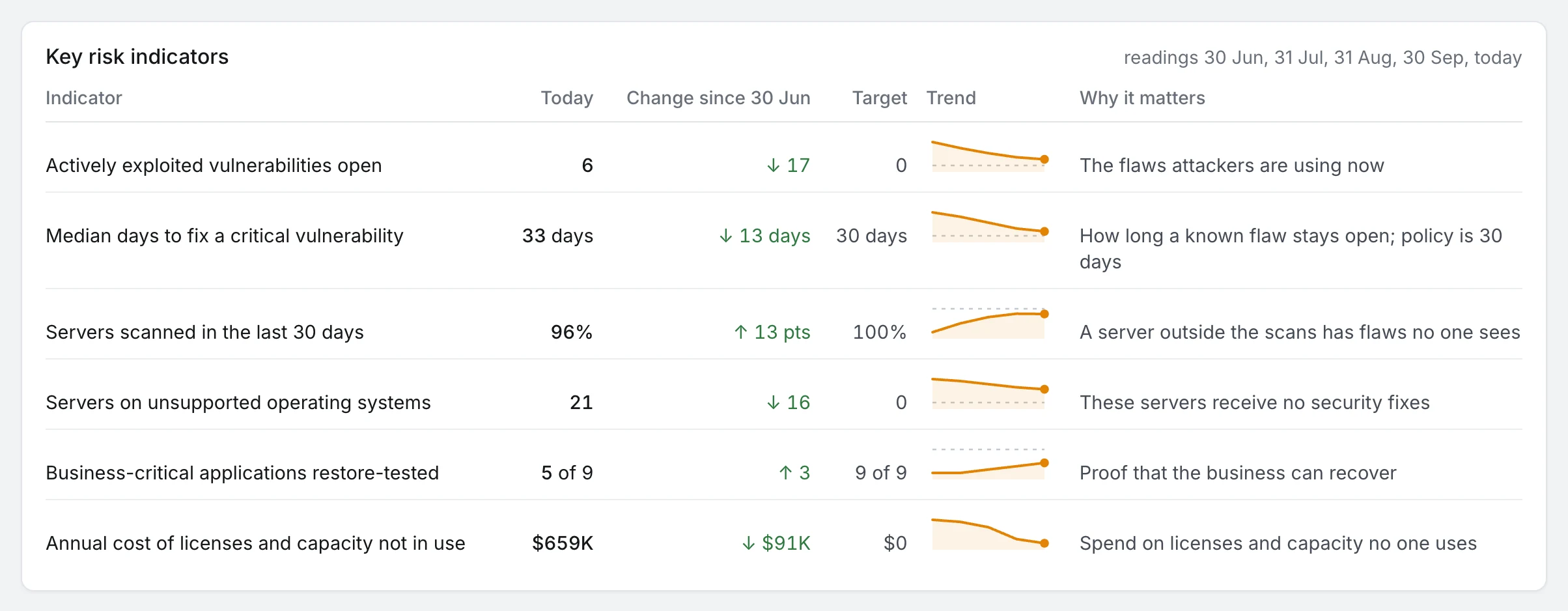
Progress reported every month against the first reading
The workspace stays connected after the readout. Each measure is read again every month and shown beside the baseline. A new risk appears on the day the data shows it.
How it works
A baseline in 30 to 45 days, with nothing to install
The assessment reads directly from the tools the teams already run, so there is nothing new to buy, deploy or configure.
Read-only access
Credentials are granted to the cloud accounts, the data centers and the security, monitoring, ticketing and billing tools.
Discovery and cross-reference
Every account, server and platform is found through its own API. Each fact is checked against a second source.
The executive readout
The top risks are ranked in business terms, with the decisions needed and the money involved. Each domain has its own page.
Progress against the baseline
Each measure is taken again and reported against the first reading, ready for the CEO and the board.
Read through each system’s own APITypical sources. Each is read with read-only credentials.
Track record
Relied on in some of the largest technology acquisitions
Slack and MuleSoft
Splunk
WarnerMedia and Discovery
Before an acquired company is connected, the acquirer receives an independent account of what it runs, how well it is protected and what it costs. A new technology leader needs the same account in the first weeks.
Independence
A paid assessment with no other work to win
Technoscope is a paid service, not a free assessment offered to win other work, so the findings carry no agenda.
Read-only from the first day
Every system is read through its own API with read-only credentials. Nothing in the environment is changed.
Nothing to deploy
The assessment uses the tools already in place. No agent, appliance or new license is required from the teams.
Findings for the executive first
The readout goes to the executive who commissioned it. Who else sees each domain is the executive’s decision.
How long does the assessment take?
30 to 45 days from the first read-only connection to the executive readout.
What access is needed?
Read-only credentials to the cloud accounts, the virtualization platforms and the security, monitoring, ticketing and billing tools already in place. Nothing is installed and nothing is changed.
How much time does it take from the teams?
Granting access in the first week, and a short review of the findings in each area before the readout. The measuring itself needs no one’s time.
What does the executive receive?
A ranked overview of the top risks, the decisions needed and the money involved; a page for each domain with its findings and evidence; and exports for the teams that carry out the work.
What happens after the baseline?
The workspace stays connected. Each measure is read again every month and reported against the baseline, and new risks appear as the data shows them.
What size of company is it for?
The assessment scales to companies of any size, from a single cloud provider to several clouds, data centers and hundreds of business applications.
Start the first year from an independent baseline
A 30-minute briefing covers the scope, the access needed and the timeline for the organization.
Prefer to look first? Open the sample assessment